Aragog
Aragog is a giant acromantula, a species of monstrous, sentient spider, who was raised from an egg by Rubeus Hagrid during his time as a student at Hogwarts School of Witchcraft and Wizardry. He becomes the patriarch of a vast colony deep within the Forbidden Forest, and his long life and eventual death are deeply intertwined with Hagrid's personal history and the larger struggle against Lord Voldemort.
Origins and Life in the Forbidden Forest
Hagrid obtained Aragog as an egg and kept him in a cupboard within Hogwarts castle. When the Chamber of Secrets was opened, Aragog was wrongly blamed for the attacks and Hagrid was expelled, but he ensured Aragog's safety by hiding him in the Forbidden Forest. There, Aragog grew to an enormous size, established a colony, and fathered countless offspring. He developed the ability to speak, communicating in a hissing, rasping voice. Aragog's loyalty to Hagrid was absolute; he ordered his children never to harm the gamekeeper, a protection that was the only thing keeping Hagrid safe from the colony's predatory instincts. Harry Potter and Ron Weasley first encountered Aragog during their second year, when they followed a trail of spiders into the forest and were brought before him. Aragog, while refusing to name the true culprit of the Chamber of Secrets, revealed that the monster was a basilisk, a crucial piece of information.
Relationship with Hagrid and Decline
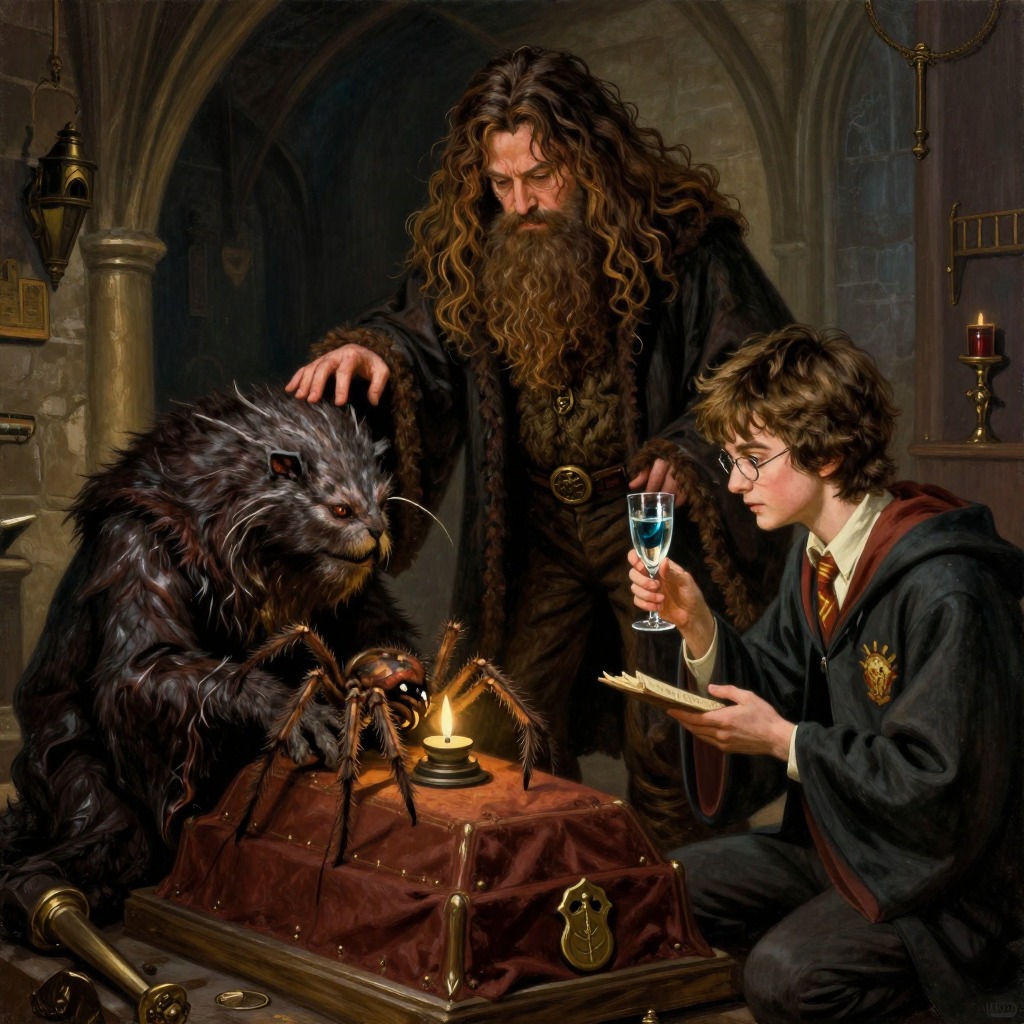
Aragog's bond with Hagrid was one of the few genuine friendships the acromantula ever had. Hagrid visited him regularly, bringing him food and company. As Aragog grew old and fell ill over the summer, Hagrid became deeply distressed, spending his days reading to the dying spider and neglecting his own duties. The gamekeeper's grief was so profound that he could not face the burial alone, leading him to write a tear-stained letter to Harry, Ron, and Hermione, begging them to attend the funeral. Hagrid's attachment to Aragog was one of his most incomprehensible monster fancies, as the spider had once ordered his children to eat Harry and Ron, a fact that made Ron particularly reluctant to pay his respects.
Death and Burial
Aragog died during the night, and Hagrid planned to bury him at dusk in his pumpkin patch, a spot he considered the spider's favorite time of day. Harry, guided by the luck potion Felix Felicis, decided to attend the burial, and his decision led him to encounter Professor Horace Slughorn in the vegetable patch. Slughorn, upon hearing of Aragog's death, expressed a keen interest in the valuable acromantula venom, which is almost impossible to procure from a living specimen. He agreed to accompany Harry to the burial, ostensibly to pay his respects but in reality to harvest the venom. During the funeral, Slughorn gave a eulogy, and while Hagrid was overcome with grief, Slughorn surreptitiously collected a bottle of venom from the corpse. This act of shared mourning and Slughorn's subsequent drunkenness created the perfect opportunity for Harry to finally persuade the Potions master to divulge the true, unaltered memory of his conversation with the young Tom Riddle about Horcruxes.
Narrative and Thematic Significance
Aragog's death serves as a crucial plot mechanism, enabling Harry to obtain the memory that reveals the secret of Voldemort's immortality. Beyond this, Aragog represents the deep, often misunderstood, loyalty that Hagrid holds for magical creatures, a loyalty that is both his greatest strength and a source of personal pain. The acromantula's existence also highlights the hidden dangers of the Forbidden Forest and the complex ecosystem that exists alongside Hogwarts. His colony, which became restless and dangerous after his death, underscores the fragile order that Aragog's singular will maintained. The centaurs, who also inhabit the forest, paid their own tribute at Dumbledore's funeral, a reminder of the interconnectedness of all magical beings within the world of the story.